Gotabaya Rajapaksa: Sri Lanka's ousted former president returns
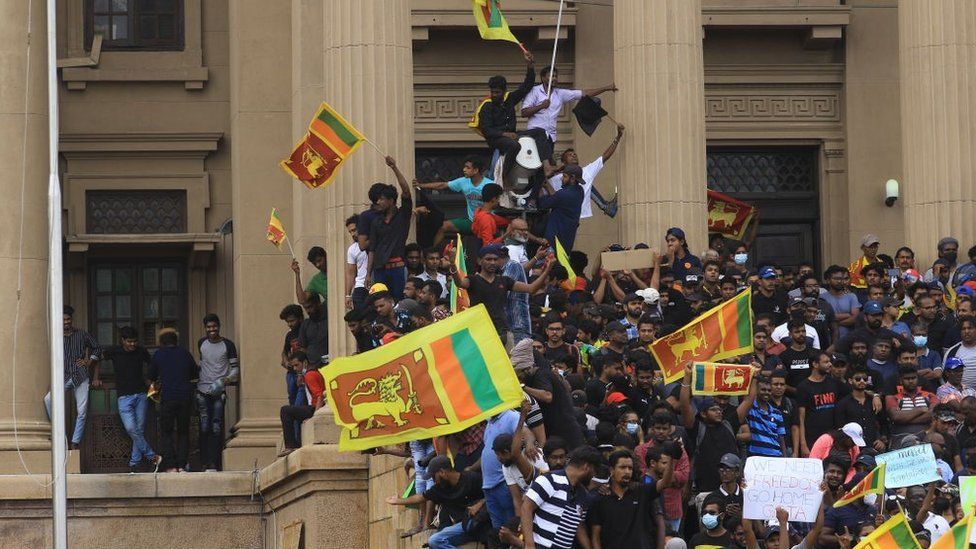
Sri Lanka's previous president Gotabaya Rajapaksa, who escaped abroad after mass fights in July, has gotten back to the country.
Mr Rajapaksa had been remaining in Thailand on a brief visa and flew back home by means of Singapore.
A few Sri Lankan priests are accounted for to have met him at the air terminal.
Sri Lankans fault his administration for the island's most awful monetary emergency ever. A breakdown in unfamiliar cash prompted critical deficiencies of food and fuel.
Fights started in April, following a sharp expansion in food and fuel costs.
Countless individuals from varying backgrounds and all networks participated in the to a great extent quiet fights requesting the renunciation of Mr Rajapaksa and his senior sibling Mahinda, the then state leader who quit in May.
In July huge number of individuals raged his authority home, and the shamed president then, at that point, escaped on a tactical plane first to the Maldives and afterward to Singapore, from where he sent in his renunciation. That prepared for veteran government official Ranil Wickremesinghe to become president.
Mr Rajapaksa's return is a delicate issue for the new government which doesn't need more fights and should guarantee his security.
"We are in favor of the arrival of Mr Rajapaksa. Any Sri Lankan resident can get back to the nation," Father Jeewantha Peiris, a noticeable dissent pioneer, told the BBC.
"Individuals came to the roads due to the supposed debasement against his administration. We have no private animosity against him."
Different dissenters say they will go against any endeavor by Mr Rajapaksa to rejoin legislative issues or the public authority.
"After he returns, we really want to make a lawful move against him for the mix-ups he committed as president and furthermore record bodies of evidence against his sibling Mahinda Rajapaksa," another dissident Rajeev Kanth told the BBC.
Sri Lankan media reports say the public authority has recognized a house in focal Colombo for Gotabaya Rajapaksa yet it's not satisfactory whether he will go straight there or to a safe military office first.
A guard service representative let the BBC know that Mr Rajapaksa "would be given security as a previous president".
The six-time Sri Lankan PM who became president
For what reason is Sri Lanka in emergency?
The everyday disaster of life in a nation failed
'Fights have improved thinking'
After Mr Wickremesinghe assumed control over the administration, freedoms bunches blame the public authority for doing a crackdown on dissenters. Handfuls have been confined by police lately, with most since delivered on bail.
Three understudy association pioneers, who drove the fights, have been in detainment under the draconian Prevention of Terrorism Act.
Dissenters blame President Wickremesinghe for lacking authenticity and public help and furthermore of safeguarding the Rajapaksa family. The public authority says making a move just against those are associated with violating the law.
Troops obliterated the dissent camp before the president's secretariat in Colombo in the third seven day stretch of July. Dissenters additionally left the Galle Face region on Colombo's ocean front a month ago.
In the beyond couple of weeks, the public authority has smoothed out fuel supplies with a pass - just enrolled vehicles with a QR code can purchase fuel at gas stations. However, fuel is still popular with lines outside some filling stations.
Key food things are accessible in shops, yet costs are high as expansion is drifting around 65%.
Recently the public authority agreed with the IMF for a $2.9bn (£2.52bn) credit. It would be reliant upon heaps of conditions, including financial changes and rebuilding Sri Lanka's $51bn obligation with its lenders.
The public authority likewise faces difficulties in persuading individuals about privatizing key public area units as a component of its endeavors to support income. Worker's guilds may firmly go against any employment misfortunes because of privatization.
Sri Lanka's resistance government officials say what is happening is misleading quiet right now and on the off chance that the fuel and food supplies are intruded on once more, further fights can't be precluded before long.
Media inscription,
Watch: Shot dead by Sri Lankan police while attempting to get fuel
Sri Lanka: The fundamentals
Sri Lanka is an island country off southern India: It won autonomy from British rule in 1948. Three ethnic gatherings - Sinhalese, Tamil and Muslim - make up the vast majority of the country's 22 million populace.
One group of siblings has overwhelmed for quite a long time: Mahinda Rajapaksa turned into a legend among the larger part Sinhalese in 2009 when his administration crushed Tamil dissident radicals following quite a while of harsh and ridiculous nationwide conflict. His sibling Gotabaya, who was guard secretary at that point, became president however stopped after mass fights.
Official powers: The president is the head of state, government and the military in Sri Lanka yet shares a ton of leader obligations with the state leader, who heads up the decision party in parliament.
A monetary emergency prompted wrath in the city: Soaring expansion has implied a few food varieties, medicine and fuel are hard to come by, there are engineered power outages and customary individuals rampaged out of resentment recently, with many faulting the Rajapaksa family and their administration for the circumstance.
Comments
Post a Comment